
How to approach AI in Design Thinking and for UX research workflows
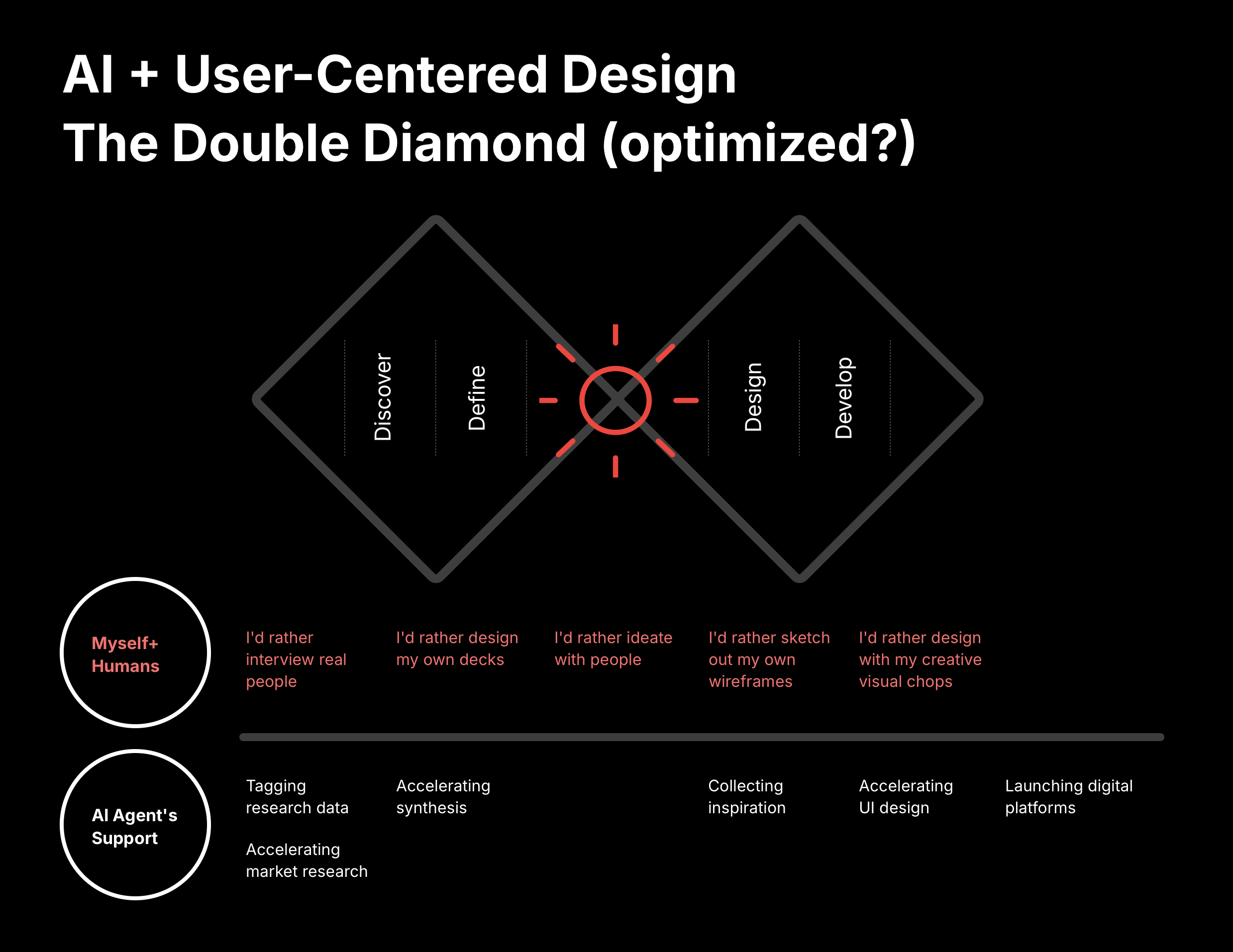
For Design Thinking
There has been a lot of change in the Design Thinking community with explorations of AI agents to optimize the practitioner’s workflow. Some are utilizing AI for almost every single touchpoint, including interviewing an AI agent in replacement of a human customer, when others are focusing on leveraging it more for proposing interview guides, ideating, and designing products.
While AI has a lot to offer, it is key to take a step back and maintain agency for the designer as a strategist who is in control of the process, protecting the creativity and ethical agency that comes with it, when navigating client projects. AT RZD, we believe, that AI is best suited as a tool that follows an order that follows a strategic thinking process.
For UX Research
UX Researchers used to spend lots of time sifting through large amounts of data, coding them, and extracting meaningful insights from large research studies to translate to meaningful UX design ideas. What took a whole week can now be automated in a few clicks. However, when some are treating AI as a human and if AI is trusted blindly, the level of risk increases.
UX directors from Hyatt and JP Morgan who explored the shifting role of UX Researchers in the age in a talk with Smart Design in December 2025, highlighted the fact that while AI is now supporting us in research synthesis, we should still attend to it with a risk-averse mindset.
Their take on ai influencing research workflows include these takeaways:
⌛ Efficiency vs Time:
The euphoric moment of uncovering insights is still a human delight for researchers (L2, L3 insights). There is importance and hope in ai not taking that away.
✳️ Low Risk x High Complexity = Can be automated.
This framework that is used at JP Morgan can help researchers become better and faster.
🪵 For emerging researchers, going into 2026, it will be key to:
Practice storytelling, learn the language of the business, and be heavily invested in the craft: Digging deep into the insights provided by ai and taking them to a more nuanced level.
🚪 About widening the access to data across departments:
Researchers have to remain the gatekeepers. Cognitive bias may show up more in other roles. But researchers are aware and skilled at getting to interesting data while staying neutral.
🦹♂️ Researchers should be careful not to:
Adopt the stories of synthetic users. The assumption that they would think like humans is not right. It can be a huge risk even if just 10% of the issues are not found.
Reference: https://smartdesignworldwide.com/ideas/defining-user-research-in-the-age-of-llms/
